- Free season result
- No account
- Photo stays in your browser
Seasonal Color Analysis
Take a daylight photo and see which of the 12 seasons fits your skin, eyes and hair. Your best and worst colors are placed next to your own face, and the photo stays in your browser.
Upload a photo
Drag and drop, or choose a file
JPG, PNG, WebP or HEIC
Your photo never leaves your device
- Face a window in daylight
- No filter or beauty mode
- Bare skin or light makeup
- Hair visible, eyes open
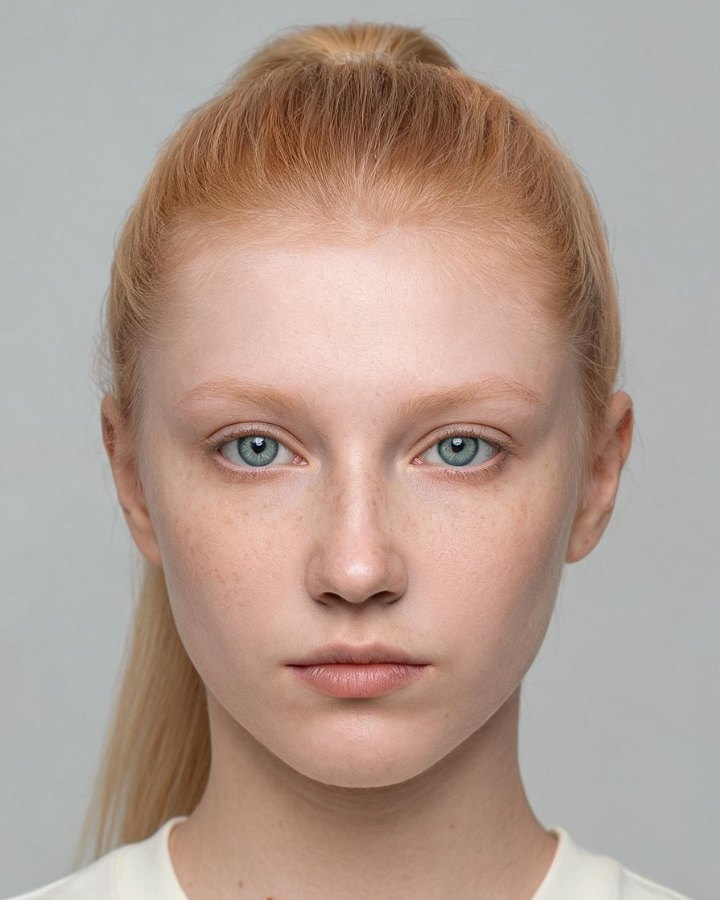
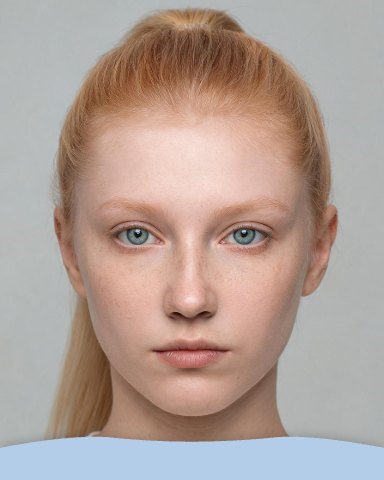 Powder blue
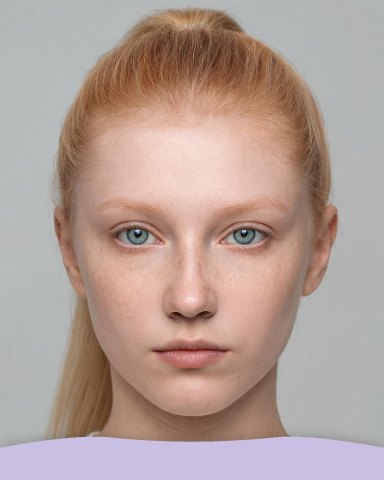 Soft lavender
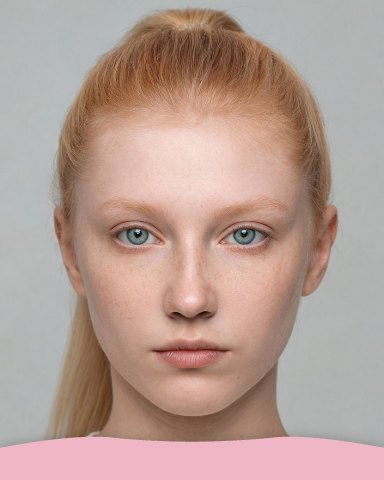 Ballet pink
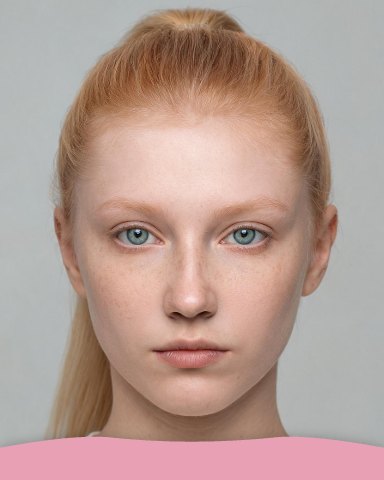 Soft rose pink
What you get
Start with the free result. Upgrade only if you want the full picture.
Free result
$0- Your season out of 12
- Confidence and the runner-up season
- Your best and worst color on your face
- A 10-color preview palette
Full Color Palette
$6.99 once- 40 to 48 named colors with hex codes, in groups
- Wardrobe neutrals and the metals that suit you
- Lip, blush and eye shades, plus your foundation undertone
- Hair colors to try
- 8 colors to keep away from your face
- Wardrobe tips for your season
- Tap any color to see it draped on your photo
- A palette card to download
Get your free result first, then upgrade from the result page.
How it works
Take a daylight photo
Sit facing a window, turn off filters and let some hair show. Light makeup is fine, and bare skin is better.
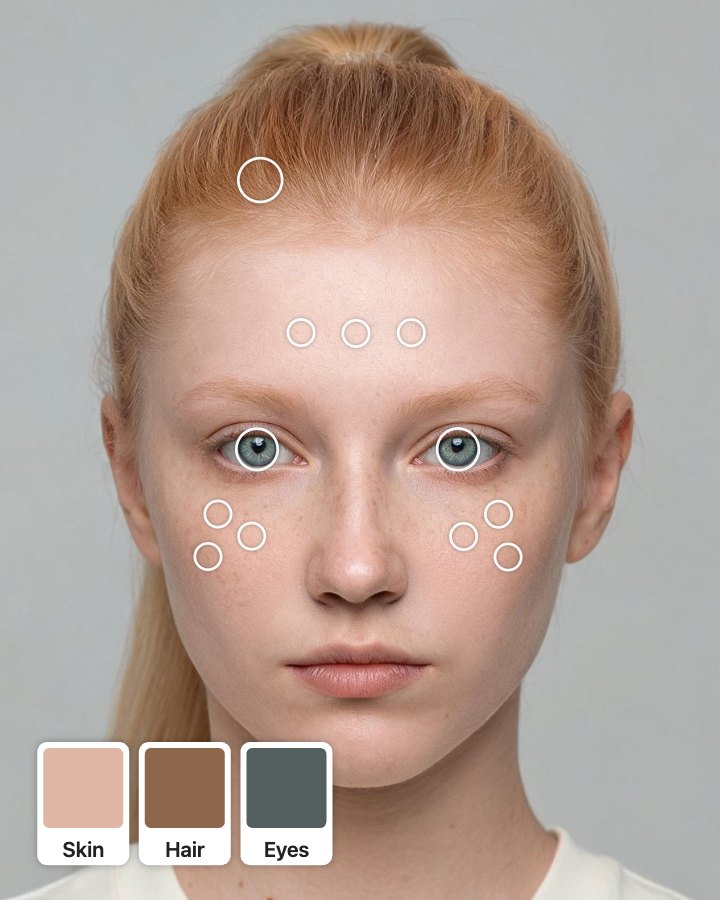
Skin, eyes and hair sampled
Your browser reads color from your cheeks, forehead, irises and hair. It uses the whites of your eyes to correct the white balance first.
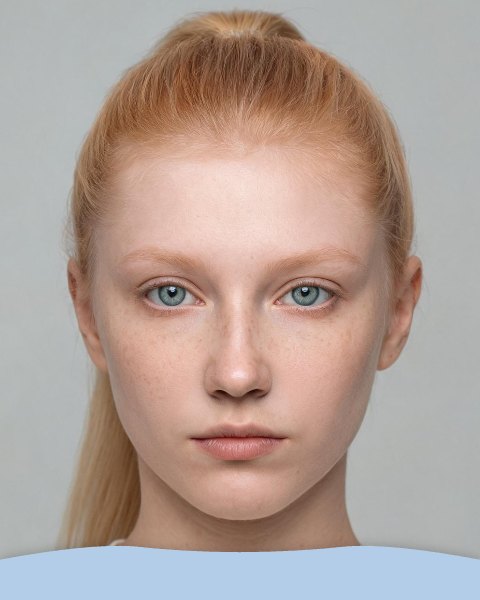 Suits her · Powder blue
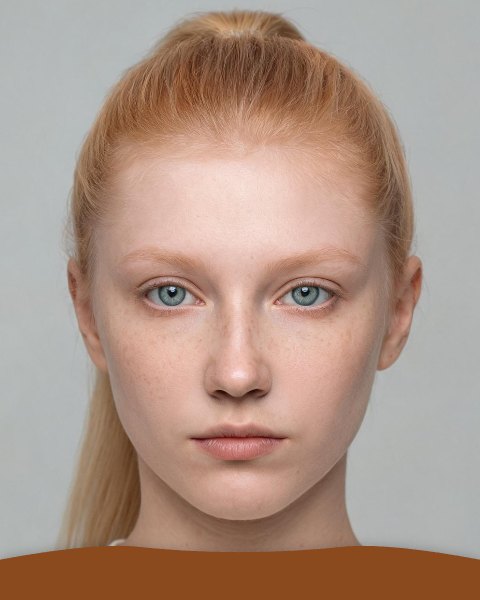 Doesn't · Rust brown
Season and drape
You get your season out of 12, a confidence score and a runner-up. Your best and worst colors are shown against your face for comparison.
What the test samples
Three samples come out of your photo.
- Skin, from small patches on both cheeks and the forehead. We drop the darkest 25% of those pixels, which is mostly shadow, and the brightest 15%, which is mostly shine, then take the median of the rest.
- Eyes, from the ring of the iris. The pupil and the reflection of the light are left out.
- Hair, from the pixels a separate hair model marks as hair.
Before these count, we fix the white balance. Eye whites have a known, nearly neutral color, so any tint they pick up in the photo comes from the light, and the same tint sits on your skin. We shift every sample back by 60% of that tint. We stop short of the full amount because the eye-white reading is itself a little noisy.
The math runs in CIELAB, a color space built so that equal numeric steps look like roughly equal changes to the eye. It keeps lightness apart from hue, which is the split seasonal analysis depends on.
Temperature, depth and clarity
The samples become three readings, each scaled so that a typical face sits near zero.
Temperature runs from cool to warm. Skin hue counts for 62% of it. Pinker skin sits near a hue angle of 44° and more golden skin near 58°. Hair adds 23%. Golden and copper hair reads warm, and ash, gray or blue-black hair reads cool. Eye color adds the last 15%.
Depth runs from light to deep. Hair counts for half, skin for a third and eyes for the rest. If no hair shows, skin takes three quarters and eyes one quarter.
Clarity runs from soft to bright. Half of it is the contrast between hair and skin. Eye saturation adds 30% and skin saturation 20%.
We measure that contrast as a ratio between the lightness of hair and the lightness of skin. A simple difference is a common shortcut in photo-based tools, and it has a known bias: dark hair against deep skin looks low in contrast, which sends people with deep skin to the Soft seasons by mistake. A ratio compares the two in proportion, so the same gap counts for more when both are dark.
The 12 seasons
Each season is a fixed point on those three scales, and your result is the nearest one. The families divide along all three: Spring is warm, light and clear; Summer cool, light and soft; Autumn warm, deeper and soft; Winter cool, deeper and clear. Within a family, the name tells you which trait leads. True seasons are led by temperature, Light and Deep seasons by depth, Bright and Soft seasons by clarity.
| Season | Coloring | Best drape | Worst drape |
|---|---|---|---|
| Light Spring | Warm, light, softly clear | Peach coral | Jet black |
| True Spring | Warm, light-medium, clear | Warm coral | Cool blue-gray |
| Bright Spring | Warm-neutral, medium, bright | Bright turquoise | Dusty mauve |
| Light Summer | Cool, light, soft | Powder blue | Rust brown |
| True Summer | Cool, medium, soft | Raspberry rose | Burnt orange |
| Soft Summer | Cool-neutral, medium, muted | Dusty rose | Bright tangerine |
| Soft Autumn | Warm-neutral, medium, muted | Soft salmon | Hot fuchsia |
| True Autumn | Warm, medium-deep, rich and muted | Pumpkin | Icy blue |
| Deep Autumn | Warm-neutral, deep, rich | Brick red | Icy lilac |
| Deep Winter | Cool-neutral, deep, clear | Black cherry | Pale peach |
| True Winter | Cool, medium-deep, clear | Blue-red | Mustard |
| Bright Winter | Cool-neutral, medium-deep, bright | Hot fuchsia | Dusty khaki |
The two drape colors are the pair your free result holds up beside your face. Look at the skin under the eyes and around the mouth. A poor color tends to deepen the shadows there.
In our 40 calibration portraits, 13 came out Winter, 12 Summer, 9 Spring and 6 Autumn. Those were public-domain studio headshots, so the split describes that set and says little about people in general.
Confidence, runner-up and corrections
Your result spreads a score across all 12 seasons, and the confidence figure is your top season's share of it. A high figure means one season clearly fits best. A lower one means your readings sit between seasons, and the runner-up shows the direction.
The Light, Soft, Deep and Bright seasons come in pairs that cross a family line and differ mainly in temperature: Light Spring and Light Summer, Soft Summer and Soft Autumn, Deep Autumn and Deep Winter, Bright Spring and Bright Winter. A runner-up from your pair means you sit close to that line.
The result also shows the skin, hair and eye colors we detected. Compare them with a mirror in daylight. If one is off, change it and the season recalculates at once. Check hair first. Hair in shadow reads darker than it is, and hair makes up half of the depth reading.
Light, makeup and hair color
Light moves this result more than anything else you control.
- Window light. Face a window during the day, out of direct sun. Warm bulbs push temperature up and open shade pushes it down. The eye-white correction removes part of that cast.
- Filters. Beauty modes and filters warm and smooth skin, which changes the exact values we read. Use the plain camera.
- Makeup. Foundation, bronzer and blush change the hue of your skin, and skin hue is 62% of temperature. Bare skin gives the cleanest reading.
- Surroundings. A red wall or a green top reflects color onto your face. A white or gray background and a plain top are safest.
- Dyed or gray hair. The test reads the hair in the photo. For your natural season, use a photo at your natural color, or set the hair swatch to match your roots. Gray hair lightens the depth reading and changes the contrast with your skin. That is a real change, and your best colors can move with it.
Photo analysis and in-person draping
A trained analyst holding fabric under your chin in controlled light is more precise than any photo test, this one included. They see your skin respond to each color directly, with no phone camera processing in between.
A photo test is easy to repeat. Run it on two or three photos taken in good daylight. If the same season comes up each time, you can rely on it more. If you book a draping later, bring your result as a point of comparison.
Privacy and payment
The face model (Google's MediaPipe, 478 landmarks) and the hair model download to your browser the first time you visit, about 8 MB. Every step on this page runs there, so the photo never reaches our server. To confirm it, open your browser's developer tools, watch the Network tab and run the test. You will see the models download and no image upload.
When you buy the Full Color Palette, the photo and your color readings are saved in your browser for up to 7 days. That keeps your palette waiting after checkout. Press "Delete my data" to clear them sooner. Stripe handles the card payment and never receives the photo. The privacy policy has the details.
Frequently asked questions
Is the color analysis free?
Yes, with no account. The free result has your season out of 12, its family, a confidence score, the runner-up, your three readings, a 10-color preview and the best-versus-worst drape. The Full Color Palette costs $6.99, paid once.
Do the vein test and the gold or silver test work?
They give a rough hint about warm or cool at best. Vein color depends on skin thickness and lighting, and a preference for gold or silver is often just taste. Neither says anything about depth or clarity, which decide most of the 12 seasons.
Does it work on deep skin?
Yes. Clarity uses the ratio of hair lightness to skin lightness, so dark hair on deep skin still counts as contrast. Tools that subtract the two tend to push deep skin into the Soft seasons. Dim light is the bigger risk, since it reads any skin tone darker.
What's the difference between skin tone and undertone?
Skin tone is how light or deep your skin is. Undertone is the hue under it, from pink to golden. The two vary independently, so two people with the same skin tone can land in different seasons. Our temperature reading is mostly undertone.
I'm between two seasons. Which palette should I use?
Start with the colors both palettes share. Then test the trait that separates them. For Light Spring against Light Summer, hold something peach and something powder blue under your chin by a window, and see which one evens out your skin.
What if my hair is dyed, gray or covered?
The test reads whatever hair is in the photo. For your natural season, set the hair swatch to your root color. With no hair visible, depth comes from skin and eyes alone, so the result is less certain and a close runner-up deserves a real look.
Should I wear makeup for the photo?
Bare skin works best. Foundation, bronzer and blush change the hue of your skin, and skin hue drives most of the temperature reading. If you wear makeup, keep base products off the cheeks and forehead, which is where skin is sampled.
Does seasonal color analysis work for men?
Yes. Coloring works the same for everyone. Men mostly use the season for shirts, sweaters and ties, the things nearest the face, and for choosing between black, navy, charcoal and brown in suits and coats. The palette's neutrals and metals help with watches and belts.
Can I wear colors outside my palette?
Yes. The palette matters most near your face: tops, scarves, frames, makeup and hair color. Away from the face, in pants, shoes or a bag, any color works. A collar or scarf in one of your colors also lets you wear a harder color underneath.
What if I'm unhappy with the palette?
Email support within 14 days of buying and we'll refund the $6.99. The palette appears on the page right after checkout and the palette card downloads from there, so you have time to try the colors first.
Find your season now
Free, takes a few seconds, and your photo never leaves your device.
Upload a photoFull Color Palette: $6.99 one-time, optional